Agentic Payments: How Agents Move Money
AI agents now initiate money movement. Sometimes they shop for a consumer. Sometimes they pay for an API call. Sometimes they operate a business account under a finance team’s rules.
Those are different jobs. They use different protocols, controls, and settlement paths, even when the same companies appear in more than one.
The revolution is delegation. A person or business hands part of a decision and its execution to software. Existing checkout, fraud, card-network, and banking systems assumed a human acted in the moment. Agentic payments must establish who the agent represents, what it may do, and how the payment is controlled.
Some of that infrastructure is live. Some is limited to pilots, betas, or proposals. Most of it is driven by the potential to reshape business as we know it and by the fear of becoming irrelevant.
This is a map of the market as of July 2026.
Three ways of agentic payments
Agentic payments covers three distinct flows: commerce, machine payments, and treasury.
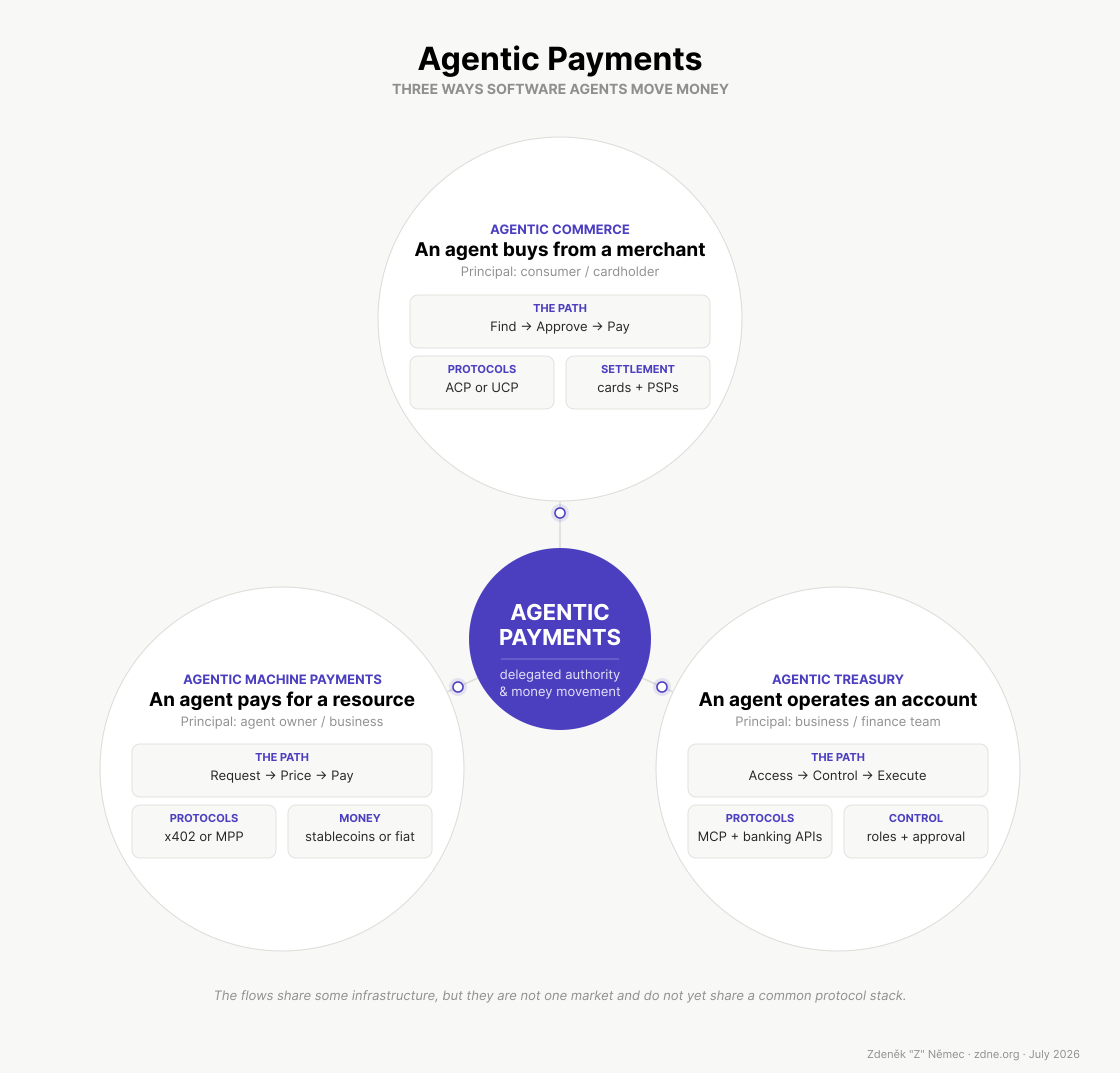
Each flow has the same cast. The principal is the person or business whose money and authority are at stake. The agent surface acts for it. The counterparty is the merchant, service, bank, or other party on the receiving side.
| Flow | Principal | Agent surface | Counterparty |
|---|---|---|---|
| Commerce | Consumer / cardholder | ChatGPT, Gemini, or another shopping agent | Merchant / retailer |
| Machine payments | Agent owner or business | Agent with a wallet | API, tool, or data-service provider |
| Treasury | Business / finance team | Treasury agent | Bank, vendor, employee, or supplier |
Commerce gets most of the attention and most of the protocols, led by OpenAI and Google. Bain’s $300–500 billion projection applies to the commerce slice; it says little about the eventual size of machine payments or treasury.
AI-assisted still has a human clicking somewhere: the agent finds options, drafts a comparison, and a person confirms.
AI-executed is the agent completing the action within rules set in advance: a budget, a policy band, or a standing instruction. Most shipped examples remain assisted; execution is emerging unevenly across the three flows.
Agentic Commerce
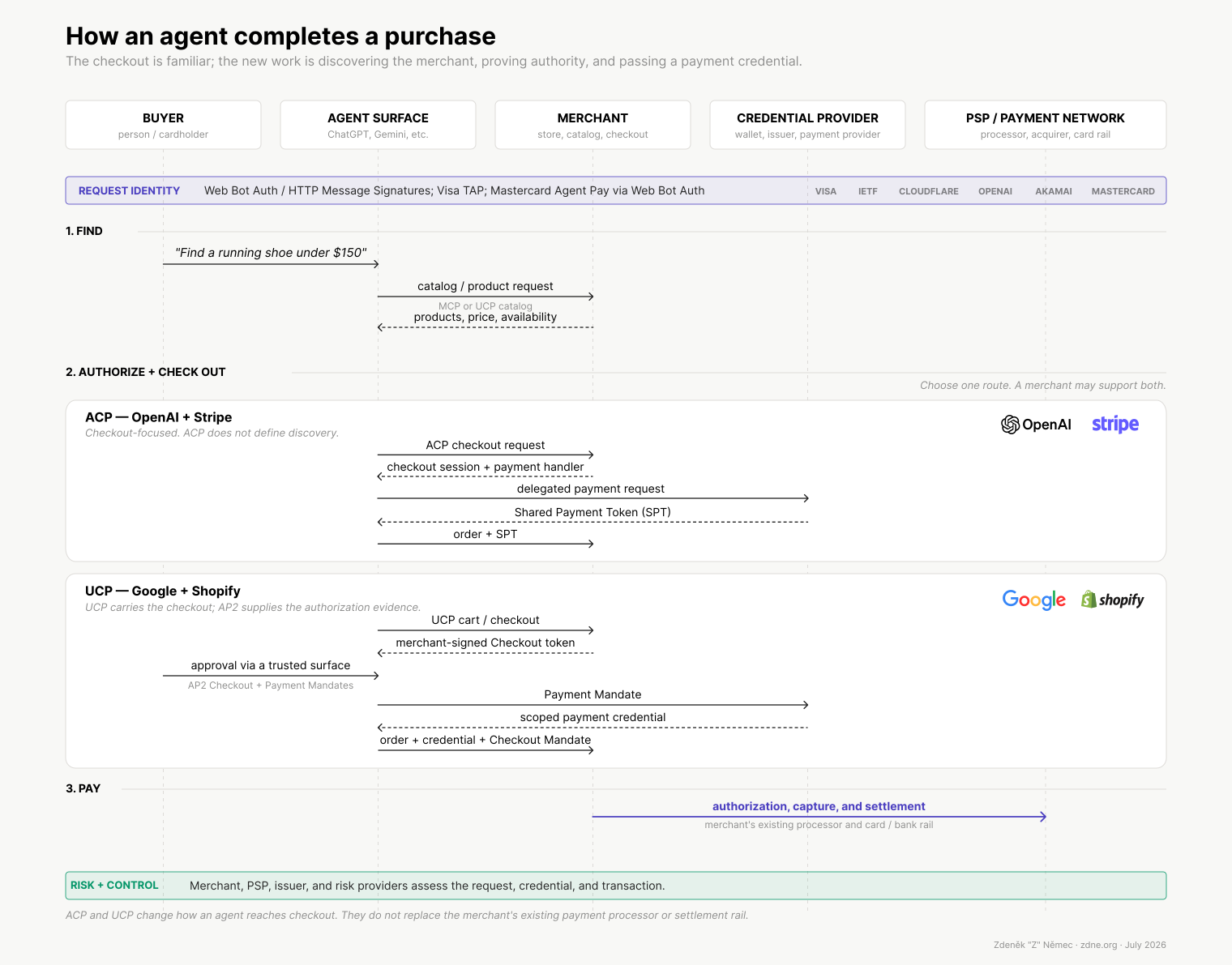
Commerce lets an agent take a buyer from product discovery to a merchant checkout. It has the most visible protocol competition.
Every agent purchase has to answer four questions:
- Can the agent find and talk to the store?
- Is this a real, recognised agent?
- May it make this specific purchase?
- How does the merchant get paid?
Commerce at a glance
| Step | The agent needs | The protocols answer |
|---|---|---|
| Find | A way to search a merchant’s catalog and call its systems | MCP; UCP catalog |
| Authorize and check out | Proof it may buy, plus a checkout interface | ACP + SPT; UCP + AP2 |
| Pay | A credential the merchant can accept and a rail to settle on | Cards and processors; emerging USDC paths |
| Establish trust | Proof of agent identity and risk controls | Web Bot Auth; Visa; Mastercard; issuers and PSPs |
Finding a merchant
The Model Context Protocol (MCP), from Anthropic and now under the Agentic AI Foundation, defines how an agent finds and calls tools on a merchant’s system. It is not commerce-specific. A merchant’s server might expose a catalog search, twenty-five payments tools, or both.
The Universal Commerce Protocol (UCP) catalog spec standardizes names such as search_catalog and get_product, reducing the need for bespoke merchant integrations. Shopify’s Storefront MCP server has conformed to it since April 2026. UCP spans catalog and checkout; the Agentic Commerce Protocol (ACP) focuses on checkout.
Two checkout paths: ACP and UCP
ACP (OpenAI, Stripe) and UCP (Google, Shopify, and a broader retail and card-network coalition) define competing checkout mechanisms. A merchant that implements only one is not automatically available to agents using the other.
ACP is a narrow HTTP/JSON checkout API. It hands off payment through Stripe’s Shared Payment Token (SPT) without exposing a raw card number. It powered ChatGPT’s Instant Checkout.
In March 2026, OpenAI said the initial version lacked the flexibility it wanted. It began letting merchants use their own checkout experiences while focusing on product discovery.
Reading between the lines of official press, merchants refused to become the ghost kitchen for OpenAI’s ChatGPT and pushed back against the Instant Checkout.
UCP spans discovery through checkout. It has native bindings into MCP and agent-to-agent (A2A) systems, with the Agent Payments Protocol (AP2) underneath for authorization.
UCP is now live for Ulta Beauty shopping in Google’s AI Mode and Gemini. Google and Ulta announced the rollout in April 2026. Visa, Mastercard, Amex, Stripe, Shopify, and more than 20 retailers have endorsed it.
Proving the buyer’s authority
AP2 provides UCP’s authorization layer. Its signed Checkout and Payment Mandates record what a user authorized. They create a tamper-evident record, not a one-time yes. AP2’s Payment Mandate proves authority; it does not replace the payment credential.
ACP does it differently. Its checkout API uses merchant-defined bearer authentication and passes a scoped payment token to the merchant.
In April 2026, Google donated AP2 to the FIDO Alliance. Visa and Mastercard now co-chair the working group that steers it. Mastercard also contributed Verifiable Intent, a complementary proof of user authorization.
Payment identity: Visa and Mastercard
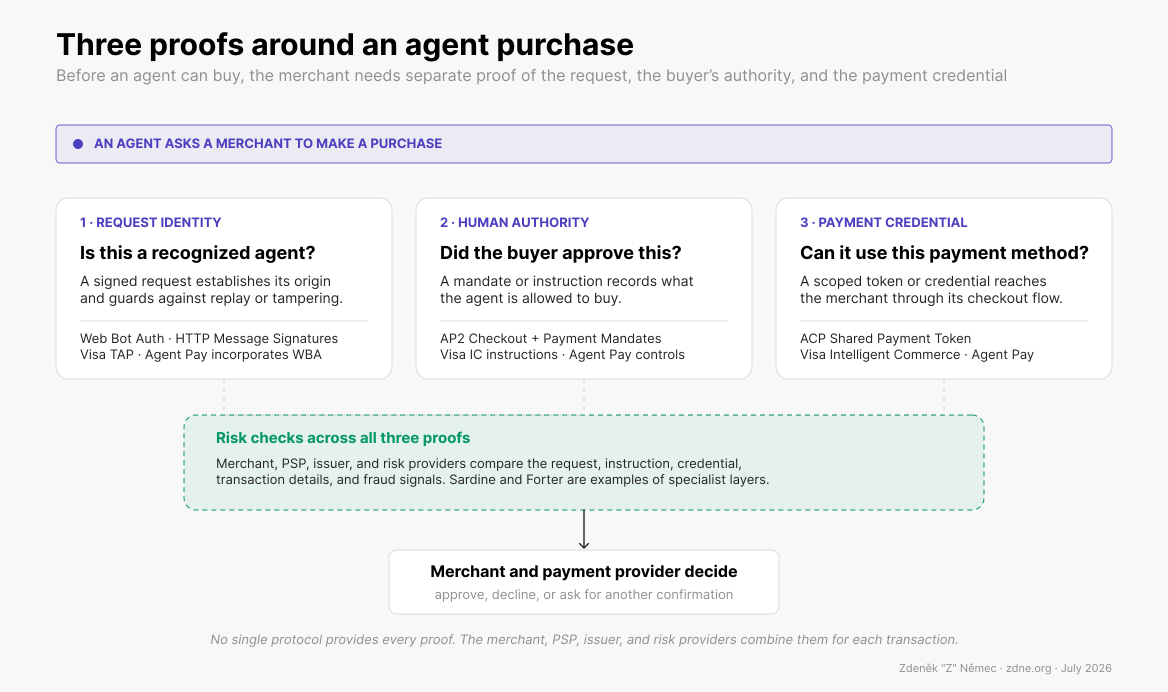
Visa and Mastercard run separate payment-identity programmes that register agents and apply payment controls.
Visa’s answer is the Trusted Agent Protocol (TAP), an identity and request-integrity component of the broader Visa Intelligent Commerce program. TAP proves who the agent is and detects invalid, expired, or replayed signed requests; it does not itself move money. Visa Intelligent Commerce adds payment and control capabilities.
Mastercard’s Agent Pay combines registered-agent identity, Agentic Tokens, and transaction controls. Mastercard describes the tokens as dynamic, cryptographically secure credentials carrying purchase-intent data such as transaction limits and validity windows.
Visa and Mastercard use different systems. There is not yet one standard way for merchants to accept agent payments.
Request signatures: Web Bot Auth
Web Bot Authentication (Web Bot Auth) is an emerging approach to authenticating automated HTTP clients with HTTP Message Signatures under RFC 9421. It lets a site verify a signed request without making it a commerce or card-network protocol.
An IETF working group is taking the work forward. Cloudflare, Amazon, Akamai, and OpenAI have announced support or implementations.
Mastercard incorporates Web Bot Auth into Agent Pay, and American Express has announced planned compatibility.
Visa’s TAP also uses RFC 9421-style signed requests.
Both share the same basic approach—signed requests—but merchants still face different protocols and verification rules.
Risk and fraud
A merchant facing an incoming agent request has to check two things: is the agent legitimate, and who is it acting for?
Sardine and Forter add different pieces of the risk stack: identity verification, device and behavioral signals, transaction-risk assessment, fraud controls, and monitoring.
Card-not-present fraud rules assumed a human confirmed the purchase in the moment. Agentic commerce makes both agent identity and the human’s authorization part of the dispute trail.
Akamai reports that commerce accounted for 47.9% of all AI-bot traffic across its global network from July through December 2025.
How the merchant gets paid
Authorization is not settlement. It tells the merchant that the agent may buy; the merchant still needs a payment credential it can charge.
ACP passes an SPT to the merchant. The merchant’s payment service provider (PSP) then processes it through the familiar card path: acquirer, card network, issuer, and settlement. UCP can use a merchant’s existing checkout and payment stack; AP2 records the buyer’s authority, not the payment itself.
Stripe says an SPT can be backed by Visa Intelligent Commerce or Mastercard Agent Pay payment methods. These programmes add agent-specific credentials and controls; they do not replace card settlement.
PSPs are trying to keep merchants from implementing every protocol themselves. Stripe, PayPal, Adyen, and J.P. Morgan/Mirakl represent different versions of that merchant-acceptance layer.
Some providers give agents controlled virtual cards instead: Marqeta supplies issuing controls, Alchemy AgentCard connects to Visa Intelligent Commerce, and Agentcard.sh issues single-use virtual Visa cards.
As an alternate-settlement example, we have built Arc Pay. It supports ACP and UCP over USD Coin (USDC) on Circle’s Arc, demonstrating that alternate rails can work in commerce flows.
Agentic machine payments
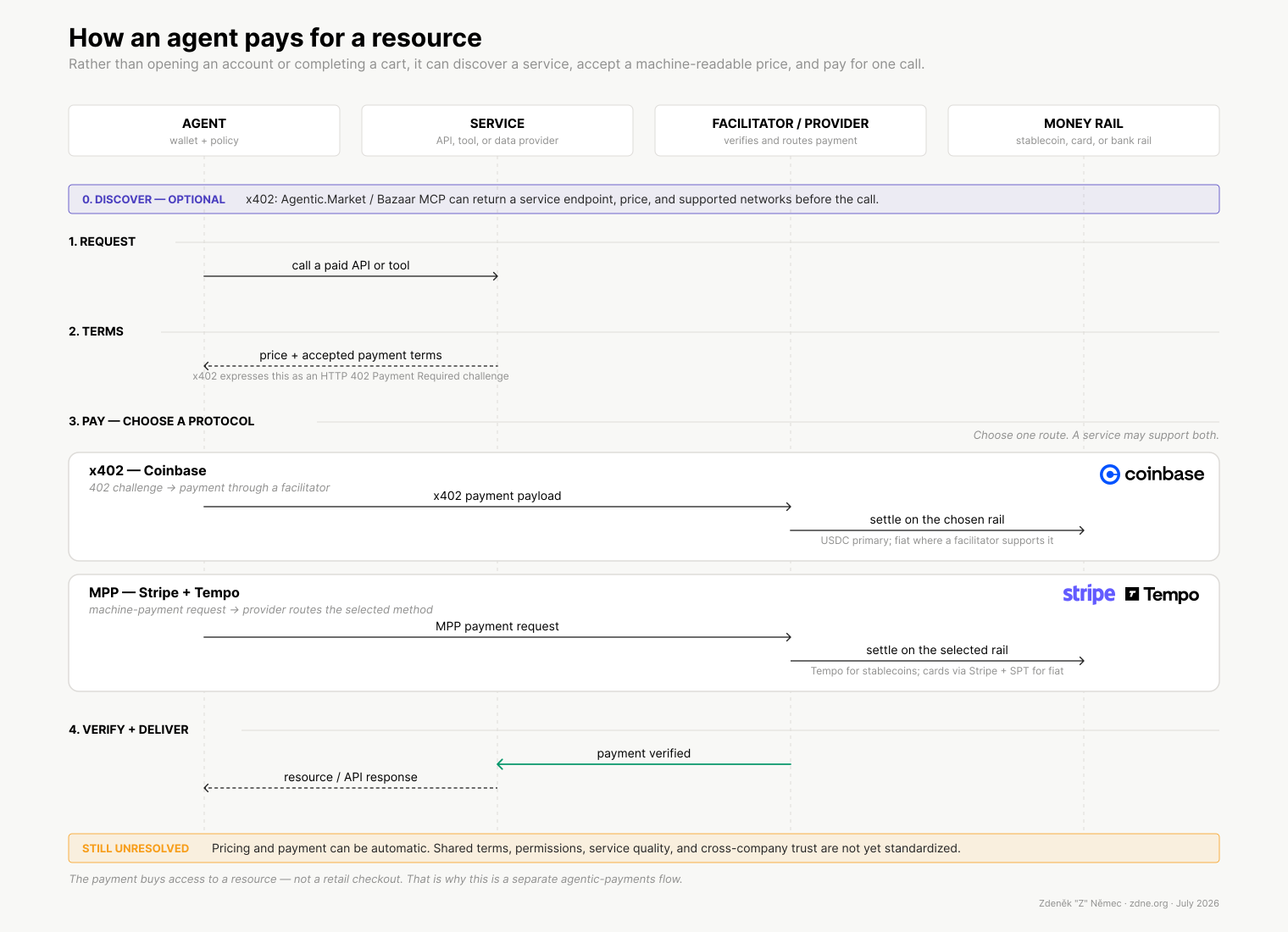
Machine payments let an agent or application pay for an API call, MCP tool, data feed, or other service rather than a shopping checkout. They are often small and frequent, but size is not the defining feature. The main protocols are Coinbase’s x402 and Stripe’s Machine Payments Protocol (MPP).
x402 has live services and a machine-readable directory. When an x402-enabled server receives a request without payment, it returns a 402 Payment Required challenge; the agent pays and retries the request. MPP is live for stablecoin and fiat payments. The open question is whether either can become a broad standard across payment methods and service providers.
x402 began as a stablecoin-only protocol. Its V2 specification opened it to fiat—U.S. ACH bank transfers, European SEPA bank transfers, and cards—through facilitators, though stablecoins remain its primary use case. Coinbase reports 165M+ transactions and roughly $50M in cumulative volume as of April 2026.
Coinbase’s Agentic.Market is a machine-readable directory of x402 services. An agent can use MCP to find and assess a service at runtime; the service returns a 402 challenge, and the agent pays per request. Coinbase donated x402 to the Linux Foundation, whose x402 Foundation became operational in July 2026.
MPP shipped with fiat and stablecoin support. It uses Tempo for crypto and Stripe’s card rails for fiat, via Shared Payment Tokens, and went to mainnet in March 2026.
MPP and ACP share the SPT primitive, but they serve different jobs. ACP uses it for shopping checkout; MPP uses it for machine payments.
Cross-company negotiation (something I’ve been chasing since 2016) — an agent agreeing payment terms with a supplier’s agent — remains much less established. It needs shared terms, compatible permissions, and trust between companies.
Currency: the money moving through those rails isn’t settled either
Protocols move value. They do not agree on what the value is.
Fiat remains the largest settlement base: real dollars moving over existing Visa and Mastercard rails. TAP signatures and Agentic Tokens are not new money; they identify or control the payment credential.
Stablecoins are contested ground. Visa’s stablecoin-settlement activity spans nine blockchains and has reached a $7B annualized run rate; its U.S. settlement pilot uses USDC. Mastercard plans to add settlement in six stablecoins across eight chains, subject to regulatory availability.
In the machine-native micropayment sample Keyrock tracked from May 2025 to April 2026, 98.6% of 176 million payments settled in USDC. The sample covers on-chain micropayments, not all agent payments.
On June 30, 2026, Open Standard announced Open USD (OUSD), with more than 140 businesses signed up. The proposed currency would offer free minting and redemption, reserve economics for distribution partners, and an independent partner board.
Open USD is an attempt to give payment and commerce companies a role in the settlement asset itself, not just the rails that move it. Its founding group includes Visa, Mastercard, Stripe, Amex, Coinbase, BlackRock, Google, Shopify, DoorDash, and hundreds of others. When a new form of money appears, everyone who can wants a seat at the table.
Agentic Treasury
Treasury lets an agent operate an account under a business’s permissions. It can open accounts, prepare wires, issue cards, and handle vendor-payment workflows.
Meow Technologies launched what it calls an agentic banking platform on April 8, 2026. Its MCP tools can create virtual cards with merchant and spend controls and can draft transfers.
Meow and other providers now expose agent-facing tools. Production access remains bounded by approval rules, permissions, or read-only interfaces. No shared treasury protocol or reliable market-volume measure has emerged.
Every MCP-initiated transfer is placed in pending approval. A human approves it in the dashboard. OAuth scopes, roles, and any multi-factor authentication (MFA) requirement are checked on each call.
Griffin, a UK banking-as-a-service platform, has a beta MCP server with tools for opening operational accounts and creating and submitting payments. Its safeguards prevent live organisation API keys from being exposed to the server.
At the enterprise end, J.P. Morgan frames agentic treasury as a control loop: sense, predict, decide, execute, audit. In its illustrative scenario, a hedge within a pre-authorized policy band can move to rapid approval while a recommendation outside the band escalates to the CFO.
To illustrate the potential: Circle’s treasury team moved more than $68M across eight entities in eleven flows in under 30 minutes in one month, using USDC via Circle Mint. The comparable fiat-wire process took one to three days.
Circle’s transfers were human-operated through established approval practices, not agent-initiated.
The size of Agentic Treasury is unclear. Broader “agentic AI in banking” forecasts bundle chatbots, fraud detection, and credit decisioning with money movement, so they do not measure this flow cleanly. Published evidence on agent-initiated account activity is still thin.
Where this leaves you
Each flow is unfinished in a different way.
Commerce has two rivalries: ACP against UCP for checkout, and Visa against Mastercard for agent identity and payment-control frameworks.
Convergence is selective. Web Bot Auth is becoming a common request-authentication approach, and Visa and Mastercard now co-chair FIDO’s AP2 work. Stripe’s SPT can support both Visa Intelligent Commerce and Mastercard Agent Pay. ACP still does not use AP2.
Machine payments are developing around paid, machine-readable services. The Linux Foundation’s x402 Foundation governs x402, not Stripe’s separate MPP protocol.
Currency is unsettled too: fiat rules commerce, while USDC dominates the observed on-chain machine-payment sample. Almost everybody in the space has backed Open USD, a proposed shared stablecoin that would compete with USDC.
Treasury is newest and least standardized. Banks and banking-as-a-service (BaaS) platforms are cautiously shipping their own MCP servers and permission models.
Agentic payments is three adjacent markets, each still deciding how an agent finds the relevant merchant, service, or account; proves it is authorized; and moves money.
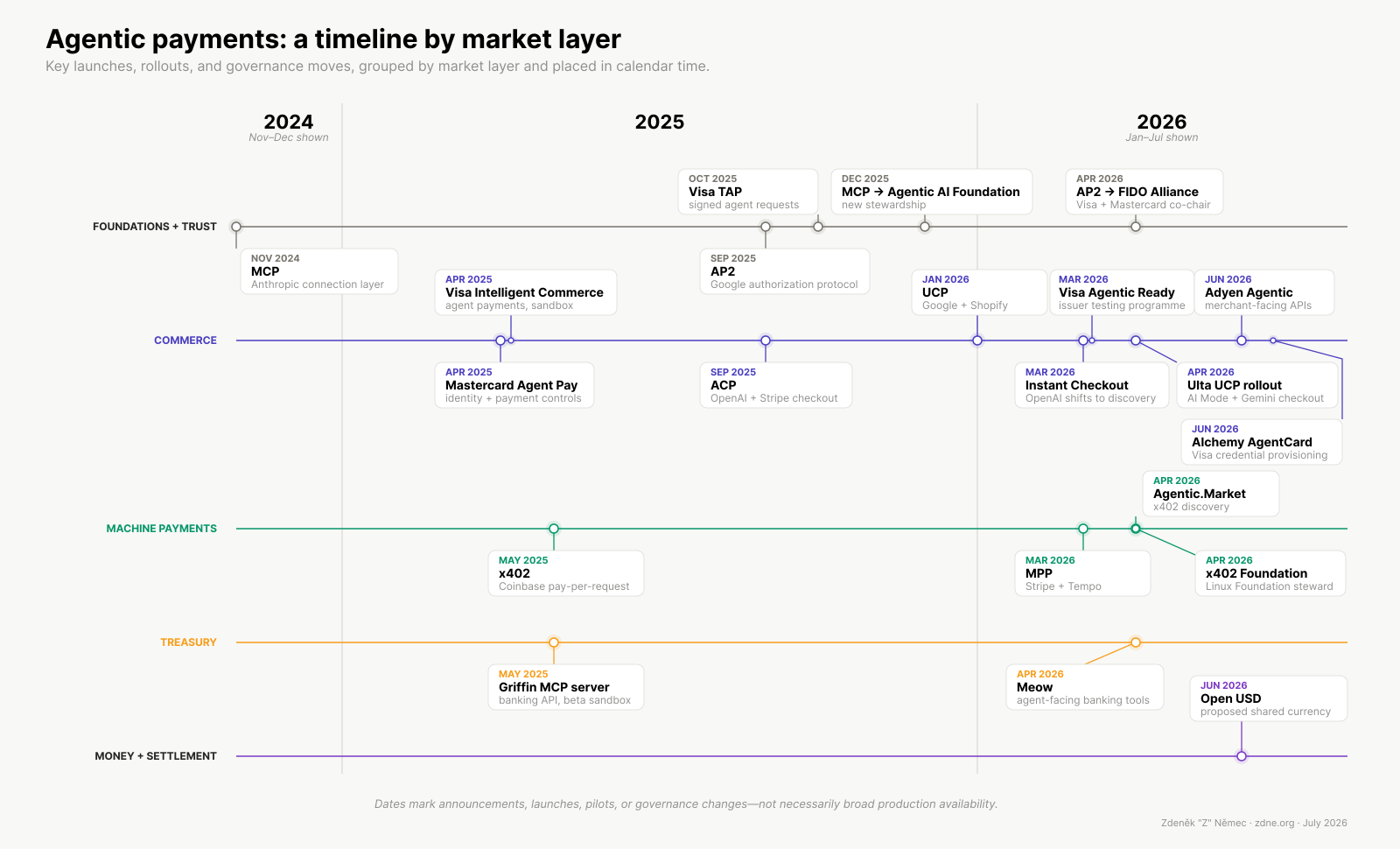
Timeline
Key launches, rollouts, and governance moves, grouped by market layer and placed in calendar time.
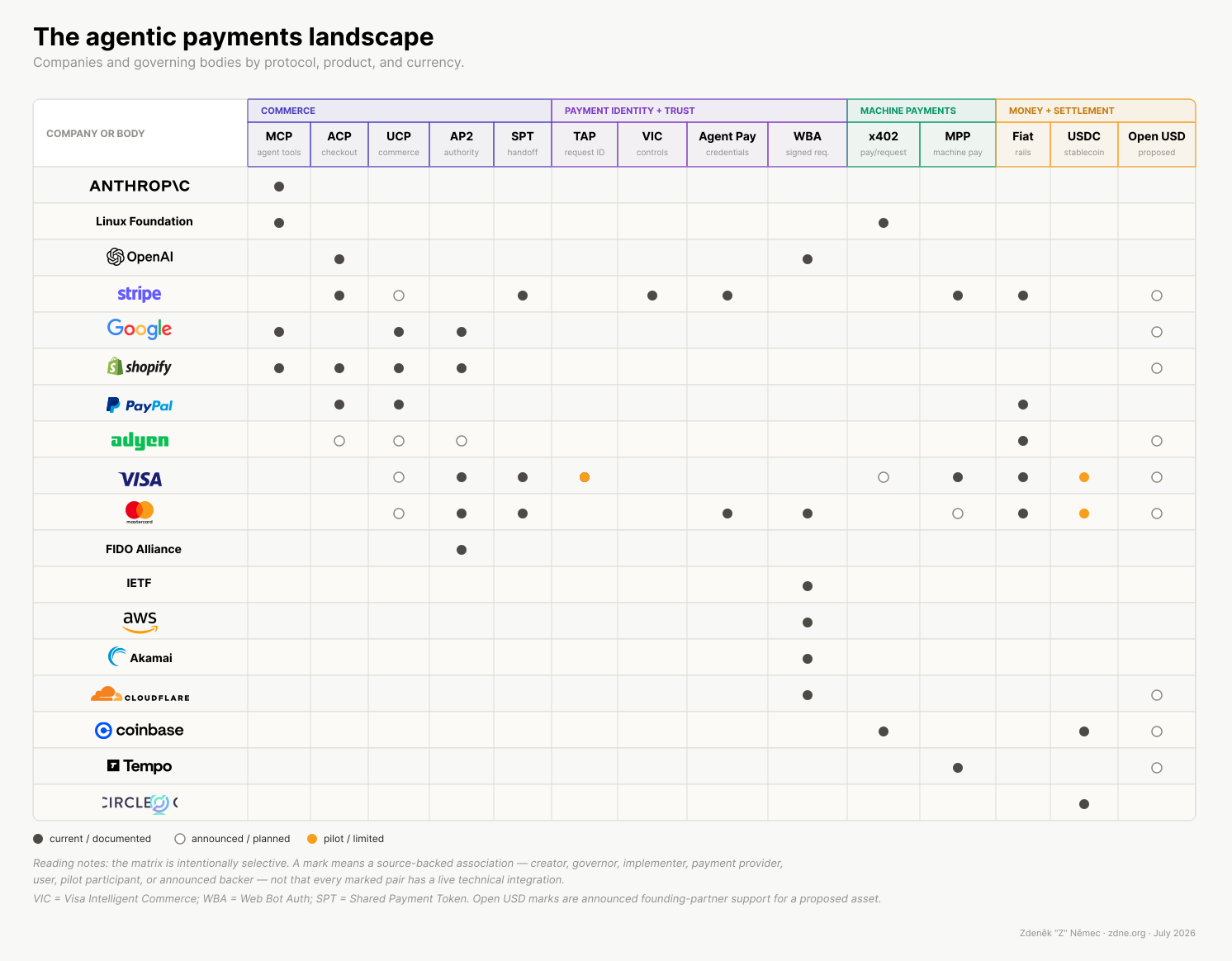
Who’s building what, with whom
The protocols, payment programmes, and companies shaping how agents discover, authorize, and pay.
Sources
Market sizing and phase framing:
- Bain & Company — 2030 Forecast: How Agentic AI Will Reshape US Retail
- J.P. Morgan — 5 payments trends to watch in 2026
Checkout, identity, and the Visa/Mastercard/Coinbase rivalry:
- Visa Developer — Visa Intelligent Commerce
- Visa Developer — Trusted Agent Protocol
- Visa Developer — TAP specifications
- Visa — Trusted Agent Protocol and x402 interoperability
- Visa — Agentic Ready in Europe
- Mastercard — Agent Pay framework
- FIDO Alliance — FIDO Alliance to Develop Standards for Trusted AI Agent Interactions
- PayPal — PayPal Launches Agentic Commerce Services to Power AI-Driven Shopping
- J.P. Morgan — Mirakl Nexus & J.P. Morgan Payments Enable AI Agent Checkout
- Marqeta — JIT Funding
- Marqeta — Commando Mode
- Alchemy — AgentCard and Visa Intelligent Commerce
- Agentcard — Terms of Use
- Arc Pay — API reference (ACP and UCP payment provider support)
- OpenAI — Powering product discovery in ChatGPT
- Google Developers Blog — Universal Commerce Protocol
- Ulta Beauty — Gemini-enabled shopping
- ACP specification
- AP2 specification
- Stripe — Supporting additional payment methods for agentic commerce
Web Bot Auth and automated-client verification:
- IETF — Web Bot Authentication working group
- Cloudflare — Agentic-commerce collaboration
- Akamai — Web Bot Authentication
- AWS — WAF support for Web Bot Auth
- AWS — AgentCore Web Bot Auth
- OpenAI Help Center — ChatGPT agent allowlisting
Agentic machine payments — settlement, direct agent-to-resource payment, and agent-to-agent payments:
- Coinbase — Introducing Agentic.Market
- Stripe — Introducing the Machine Payments Protocol
- x402 — Protocol overview
- x402 — Introducing x402 V2: Evolving the Standard for Internet-native Payments
- Linux Foundation — Launching the x402 Foundation
- Linux Foundation — Operational Launch of the x402 Foundation
- Adyen — Adyen Agentic: The Universal Translator for the Next Era of Commerce
- Tempo — Mainnet
Currency:
- Visa — Stablecoin settlement expansion
- Visa — USDC settlement pilot
- Mastercard — Mastercard expands settlement capabilities to include stablecoin
- Open Standard — Introducing Open USD
- Keyrock — Who pays the agent?
Agent-operated accounts and treasury:
- J.P. Morgan — Proof of Movement: AI, Autonomy and the New Architecture of Corporate Cash
- Circle — Intercompany Treasury Management with USDC
- Meow MCP security
- Meow MCP tools
- Griffin MCP server
Risk and fraud:
Shared infrastructure: